
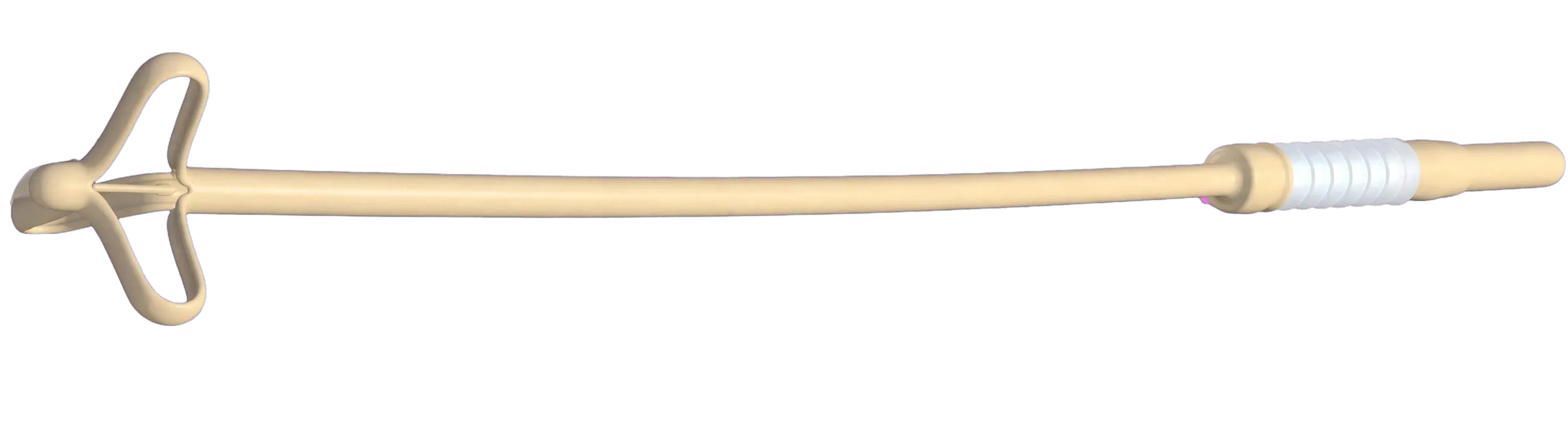
Cleared by the FDA through the 510(k) pathway for continuous drainage, continuous bladder irrigation and intermittent catheterization, whether access is urethral, suprapubic or by nephrostomy.
The Lotus No-Balloon Catheter holds its position with wings that open inside the bladder, not with a balloon.

Urine drains from the very end of the catheter, so the bladder empties completely and no residual pool is left behind.
Soft wings do the balloon’s job of keeping the catheter in place, with less irritation at the bladder neck.
A soft, supple shaft keeps the patient comfortable. It can be made in silicone, TPU, PVC or latex.
Pulling the handle open spreads the wings; pressing it closed folds them back so the catheter can be removed safely.
Every Lotus catheter is held in place by wings instead of a balloon and is sterilized with ethylene oxide (ISO 11135; SAL 10−6). Each box holds 10 units and each carton 100. Choose a hydrophilic-coated version or a non-coated one supplied with a KY jelly sachet. Shelf life is 5 years.
Male and female catheters are for adults. Pediatric catheters are for children aged 5 and older, adolescents and young adults in transition.
Adults · 400 mm usable length
Adults · 200 mm usable length
Children aged 5 and older, adolescents and young adults in transition · 200 mm usable length
| French size | Range & length | Outer diameter | Minimum flow rate | |
|---|---|---|---|---|
| ml/min | ||||
14 Fr LC-M-14 | Male400 mm | 70 ml/min | ||
16 Fr LC-M-16 | Male400 mm | 100 ml/min | ||
18 Fr LC-M-18 | Male400 mm | 100 ml/min | ||
20 Fr LC-M-20 | Male400 mm | 100 ml/min | ||
22 Fr LC-M-22 | Male400 mm | 100 ml/min | ||
24 Fr LC-M-24 | Male400 mm | 100 ml/min | ||
26 Fr LC-M-26 | Male400 mm | 100 ml/min | ||
12 Fr LC-F-12 | Female200 mm | 30 ml/min | ||
14 Fr LC-F-14 | Female200 mm | 70 ml/min | ||
16 Fr LC-F-16 | Female200 mm | 100 ml/min | ||
18 Fr LC-F-18 | Female200 mm | 100 ml/min | ||
8 Fr LC-P-8 | Pediatric200 mm | 10 ml/min | ||
10 Fr LC-P-10 | Pediatric200 mm | 15 ml/min | ||
12 Fr LC-P-12 | Pediatric200 mm | 30 ml/min |
A ready-to-use sterile tray that pairs the Lotus No-Balloon Catheter with every item needed for an aseptic catheterization. Offered in all catheter sizes.
The full technical specifications, materials and ordering details, gathered in one document.
The same balloon-free design can be produced in four materials, from premium silicone to cost-focused PVC.
Shaft cross-sections, illustrative only.
The premium choice for biocompatibility and comfort, and the material used on every Lotus SKU today. Suitable for indwelling use up to 30 days.
Biocompatibility on a par with silicone at a lower cost. Balloon catheters cannot be made from it, so it is only possible on the Lotus platform.
The cost-focused option for high-volume purchasing and budget-driven procurement.
Rooted in the original Hakki Urinary Catheter design, and a material clinical teams already know from established workflows.
TÜV SÜD evaluated the Lotus No-Balloon Catheter against ISO 10993-1. It passed all eight tests required for an indwelling urological device in contact with tissue.
| Test | Result | Tested by | Standard | |
|---|---|---|---|---|
Cytotoxicity | Complies | TÜV SÜD | ISO 10993-5:2009 | |
Sensitization | Complies | TÜV SÜD | ISO 10993-10:2010 | |
Irritation | Complies | TÜV SÜD | ISO 10993-10:2010 | |
Subacute systemic toxicity | Complies | TÜV SÜD | ISO 10993-11:2017 | |
Acute systemic toxicity | Complies | TÜV SÜD | ISO 10993-11:2017 | |
Implantation | Complies | TÜV SÜD | ISO 10993-6:2016 | |
Material-mediated pyrogenicity | Complies | TÜV SÜD | ISO 10993-11:2017 | |
Genotoxicity | Complies | TÜV SÜD | ISO 10993-3:2014 |
Tests performed by TÜV SÜD Certification and Testing. The complete reports can be provided on request for regulatory submissions and distributor due diligence.
The device meets the FDA-recognized consensus standards listed below, and the full documentation is ready to support regulatory submissions in other countries.
| Standard | Category | Edition | |
|---|---|---|---|
ISO 14971 Application of Risk Management to Medical Devices | Risk & performance | 2007 | |
ISO 10993-1 Biological Evaluation — Evaluation and Testing Within a Risk Management Process | Biological evaluation | 2009 | |
ISO 10993-3 Tests for Genotoxicity, Carcinogenicity, and Reproductive Toxicity | Biological evaluation | 2014 | |
ISO 10993-5 Tests for In Vitro Cytotoxicity | Biological evaluation | 2009 | |
ISO 10993-7 Ethylene Oxide Sterilization Residuals | Biological evaluation | 2008 | |
ISO 10993-10 Tests for Irritation and Skin Sensitization | Biological evaluation | 2010 | |
ISO 10993-12 Sample Preparation and Reference Materials | Biological evaluation | 2012 | |
ISO 11135 Sterilization — Ethylene Oxide Requirements for Development, Validation and Routine Control | Sterilization & microbiology | 2014 | |
ISO 11607-1 Packaging for Terminally Sterilized Medical Devices — Materials, Sterile Barrier Systems | Packaging | 2006 | |
ISO 11607-2 Packaging — Validation Requirements for Forming, Sealing and Assembly Processes | Packaging | 2006 | |
ISO 11737-1 Microbiological Methods — Determination of a Population of Microorganisms on Products | Sterilization & microbiology | 2018 | |
ASTM F623-99 Performance Requirements for Foley-Type Catheters (Modified for Balloon-Free Design) | Risk & performance | 2013 |
Wings that open inside the bladder replace the inflatable balloon, so urine does not pool.
Selected polymers are cleared for indwelling use of up to 30 days, and regulatory work is under way for every material option.
FDA-cleared for patients to use at home. The push-to-deploy mechanism means there is no syringe to handle during self-insertion.
A single device takes the place of Foley, Malecot and straight catheters.